I often ask myself the foundational question of: What is it to be an artist?
It’s a question that has and probably will always ponder upon me, despite dancing for 15+ years and sacrificing my entire childhood, teenage, and college years for this craft.
Does one have to be making an income to call themselves an artist? Does one have to dance at a principal level to be considered an artist? Does one have to be dancing or have danced at a company to be considered an artist?
My coach told me I have what she calls “shifting goalpost” syndrome. For me, the goal kept shifting...just for me to feel deserving of calling myself an artist. First it was to sign a contract at a somewhat reputable ballet company. Check. Then it was to make money/get a taxable income from dancing. Done. Then it was to get a full company artist job offer. Done again. Then it was to be at a “more reputable” company and make “it” more consistent.
What’s the real definition of being an artist?
Then I question why I feel the need to make this a money making engine. Why should monetization of a passion be a benchmark? Sure, if I had to live dependent on this as my main source of income but that’s not the case at all for me now. So why do I hold myself to these benchmarks and again, why does society encourage everything to be a money making engine?
None of this may matter to the average person. The reason I care so much is because I’ve single handedly made this into an identity space for the majority of my life. And it’s the identity I’ve created for myself since the age of 5, that’s the bottleneck.
The question recently has become how does one detach their self worth from or “simply” let go of an identity they’ve designed for themselves?

“I will always be a dancer. It’s really about letting go of the standard and narrative I’ve held against myself to when I dance” (Rina’s journal entry Sep 18, 2025)
In what seems like years, I’ve been trying to put together my thoughts about how I feel towards ballet. Thinking through what I want to do with ballet in my life, what ballet means to me in my life today, and how I can truly detach from it.
Why do you care so much? “Dramatic” could be the response.
It’s a confusing place to be. The journey of answering the question of detachment has been a whirlwind. I’ve even tried brute forcing myself out of this identity, seeing how long I can last without dancing.
It feels almost like a teenage rebellion and a yearning for death at the same time. That’s how torturing the feeling of unwillingly tying your identity to this art has been. The craft is obsessive despite changing careers and not even desiring a ballet career anymore.
I have absolutely no intention of going back to dancing full time at a ballet company but at the same time, I crave performing. Though I’ve spent the last few years training solely for myself, my mind always goes to the place of “for what?” or “Is there anything else I can do in ballet within the parameters I’ve set for myself and in respect to my life I’ve built for myself today?”
So I did something really scary. Reflecting back on last year, I’m honestly impressed on what I was able to execute on, where I re-stepped into the professional ballet world and carried out a crazy personal experiment testing my relationship with ballet today.
I didn’t know what I wanted as an outcome. I just had a strong desire to do this experiment and find out anything I can possibly find out.
There’s always this lingering thought. What would have become if I kept going? Should I have kept going? Should I have just sucked it up? but if I did, what are the chances I end up hating both the craft and myself in the process?

My first performance at my NY ballet school after moving from Singapore, 13 yrs old

Backstage moment at ADC International Ballet Competition, 15 yrs old

Last CCM performance, 19 yrs old

U.S Prix de Ballet, 2nd place, 18 yrs old

Vassiliev Ballet, 19 yrs old

Post IBStage gala performance and the day I turned 20
At the age of 20 years old, it was rare for me to trust a “gut feeling” over the 15 years of working towards the “dream” I was finally living- dancing with this ballet company in Spain, surrounded by dancers of the pedigree I could’ve only dreamed of dancing with. I was finally in the room I was dreaming to be in.
But that acute feeling of my gut telling me that something was wrong, that this isn’t how it’s supposed to be - I remember vividly though I didn’t want to admit it.
On April 20th 2021, a year and some after I changed careers, I wrote about it. It went semi viral and my inbox got flooded with comments and personal stories relating to mine.
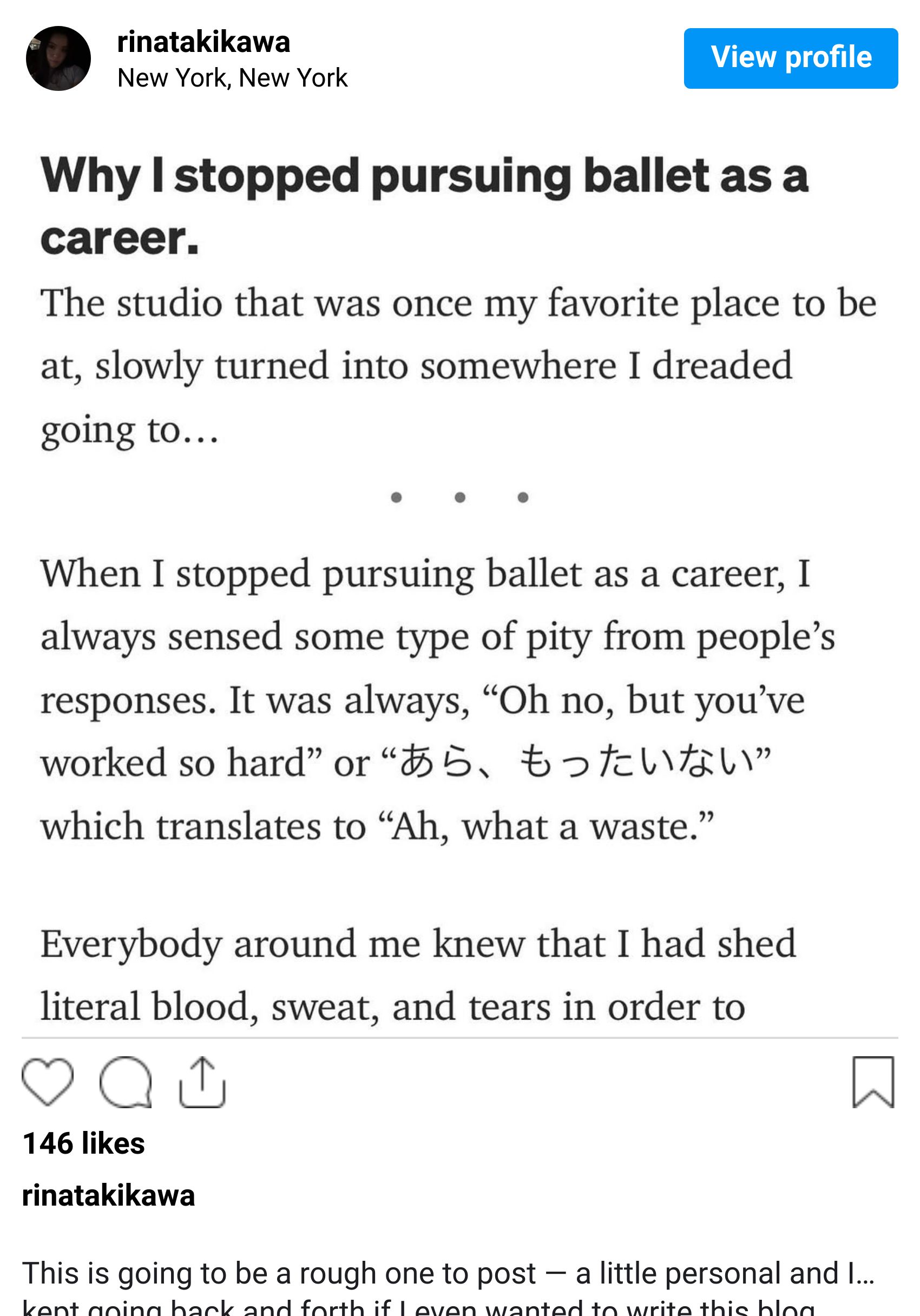
I’m glad I wrote that piece, it was sort of my way to announce to my ballet community that they probably shouldn’t expect anymore ballet content from me while also not needing to give the speech over to my friends and parental acquittances (who knew me as “rina the ballerina”) I just wanted to rip the bandaid, which I thought I did but my 21 year old self at that time didn’t see this dilemma I’m facing right now coming.
What I didn’t anticipate was the paradox waiting for me. It wasn’t as easy to get back to dance on a ‘just for fun’ basis…turns out it’s far more difficult to shrink something that once defined you.
2025 was the year of the snake. The year of leveling up your identity, and in order to do that, reality requires that you shed. In hindsight, 2025 was the year I finally admitted how desperately I needed to do the hard healing of letting go of this version of myself. It’s time to move on.
Sometimes I just want to say that yes it’s actually not that serious or that I am actually just being dramatic.
The experiment
It wasn’t until exactly this time last year when all of this started. I felt I had nothing to lose for ballet, that I finally decided to take on this experiment. I began rigorous training on my own, with the mentality of approaching movement and dance a whole lot differently, and I went in knowing a lot of healing had to be done.
I’m grateful that I can even be in this position of not being desperate for a “ballet job” or that I had nothing to lose for ballet. Teenager Rina would’ve never dreamed of this type of power.
The objectives for this experiment were 1) Can I still do it professionally? 2) Do I still want to do it professionally? 3) IF yes to both, find out before I reach the age in which is too late to get an answer 3) And most importantly, face my triggers and trauma surrounding this ballet field.
Why go to this extent? One could argue for egotistical selfish reasons, which is partially true but it was more so the unknown unknowns of not knowing where I stood with this childhood dream of mine.
And I wanted some clarity at the very least.
But. This time, it’ll be different. The approach I’d be taking would be different from pre career change intended trajectory. My dream isn’t to be a full fledged ballerina anymore. I don’t want to do it full time, nor do I want to dedicate my whole life to this anymore. Because I now know and love the world outside ballet.
I didn’t know what I wanted as an outcome. I just had a strong desire to do this experiment and find out anything I can possibly find out.


My epiphany about letting go of ballet. Slowly…It’s served me well enough. No more torturing myself. I’ve done the best I can.
Now I use it and mold the craft into how I see best. Not in a traditional way, but in my own way.
I want to stop tying my worth to the ballet ambitions of little Rina…
The Results:
Invited to take company class as auditions with ballet companies
Private coaching with Joseph Gatti
1 summer intensive at a ballet company in Chicago catered to professionals and advanced dancers (went through with it)
1 summer opportunity to participate in a choreographic summer project at a ballet company in London (went through with it)
1 full time company artist contract at a ballet company in Dallas Fort Worth (declined the offer)

June 2025, Chicago. Balancing my days building my startup and spending half days dancing. Thank goodness there was an office here.

The offer letter (that I ended up declining)
The real results I realized mattered more than the offers were on personal growth and reshaping how I viewed ballet.
I put myself back in cutthroat audition environments. It tested my mental defense - which I’ve learnt is very different from discipline.
I applied the same startup ‘mvp’ mindset to cold outreach to ballet companies (mvp: minimum viable product. aka the most basic, functional version of a product)
I placed myself in intimidating rooms, dancing alongside dancers who felt too intimidating to approach. It allowed me to question why I felt intimidated and to decode what intimidation meant for me (I’ve validated the learning here not only just applies to ballet settings, but applies to every arena of my life)
dancing at the London based ballet company was one of the first times I felt genuinely safe and welcomed, while still being surrounded by extraordinary talent. It was a juxtaposition, it showed me that this unknown anxiety can still exist even in rooms filled with kindness and support which then led to a finding on the dilemma of perception which needs to be it’s own post.
another big learning was the personal insight of the correlation between anxiety and being performative. It’s not a combo that works for me and it explains why dancing for others or being in the mentality of “proving” ends up hurting my performance. (Also another one of those learning that came from this ballet experiment but is validated to be applied to all types of situation for me)
It was grounding to hear the perspectives of dancers who’ve taken breaks or shifted careers. Including dancers who have recently retired and others who, like me, manage dual paths. Seeing dancers who don’t fixate solely on dance and who pursue other passions and careers is deeply fulfilling and almost fixes something in me. One of the dancers I danced with in London said “The best dancers I know are the ones that have a life outside ballet, who have traveled and experienced life. No one can replicate that and it cascades into the emotional side of performing. It’s pretty powerful stuff” I only wish I had understood this perspective earlier in my career.
And then, some practical advice on helping me navigate the dilemma of letting go, that surfaced in some conversations
Dance doesn’t have to be confined to one form: Movement can shift and still remain meaningful. And it might satisfy the passion without all the baggage
It remains part of you: Dance doesn’t have to leave you. Ballet is inevitably part of your identity. You don’t have to get rid of it.
Carry forward what fulfills you: Instead of framing it as loss, he spoke about carrying forward what fulfilled him including discipline, musicality, storytelling and integrating those elements into his new career.
Follow love, not obligation: The only thing that truly matters is if you love it. If you love it, dance. If you don’t, don’t. (from Marika Brussel, one of the choreographers I look up to, who also referenced and shared this poem-attached below)


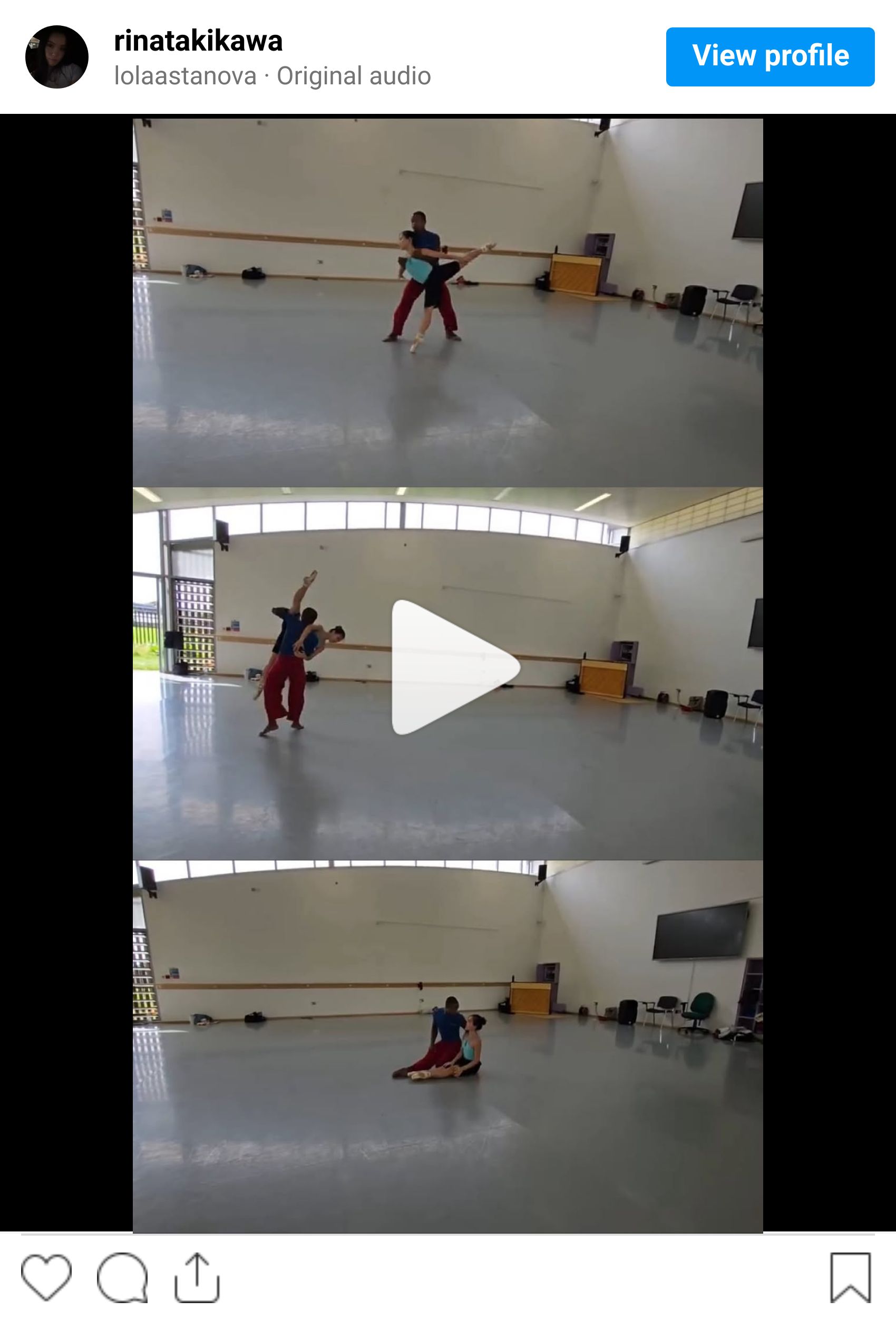
Everything aside, I felt honored to be back in these rooms, to be told to “Never stop dancing”, to have my movements and dance be complimented by the dancers around me, and to be acknowledged as a dancer still despite my unconventional journey.
What a privilege to be able dance, to know how to express with movement, to be able to release with dance, to be and have been able to dance at a professional level.
What a privilege that I got to do both.
And maybe that’s good enough..
Ending takeaways and thoughts
My coach taught me “The deathbed framework” and I think it’s important to use it when you need to step back and evaluate importance: What would you have been proud of doing if you were to look back on your deathbed? This thinking makes me re-evaluate decision making from a value first process
Redefine success on your own terms. Redefine the narrative.
The goal can stay the same, the approach can be different
Committing your life to a craft for the majority of your life speaks volumes, so I’m proud of you.
My therapist also once said “If it weren’t for your decision to leave ballet and change careers, you would be living a life with zero control or freedom. You gave yourself the freedom of choice and a chance at happiness and freedom…” That was kept in my notes from 2023 and I think it’s about time I share it.
“I wouldn’t say that I’m a healed ballet girly yet but I think I’m slowly accepting the decision of wanting to let go.”
Lastly, I want to end this piece with a quote by my stats professor! I was listening to a podcast he was featured on recently and it feels like the right note to end on. It’s a reminder that trusting yourself to let go can lead into something greater and fuller than holder on ever could.
“I’ve been that person who knew what I wanted and it didn’t work out…Life is surprising and unpredictable, and you never know where it will take you and sometimes it turns out better than you think. Everything is transferrable. Everything I’ve learnt led me to where I am.
With gratitude to everyone who shared their stories and perspective during our conversations including…
Damani Williams, Royal New Zealand Ballet
Darcey Brussel, Royal Ballet
Marika Brussel, Choreographer
Louis DeFelice, New English Ballet Theatre & Barre Trash
Nicholas, New English Ballet Theatre, National Ballet of Canada
Maidie, New English Ballet Theatre, Royal New Zealand Ballet
Chloe, my good friend that I did this whole euro trip with
Bea, coach
Boris, ex-collegue who’s a software engineer and musician
If you found anything in this piece helpful, I’d love to connect ❤
Take a screenshot of your favorite part and let’s chat about it. Hit reply to this email, or connect with me on Linkedin or Instagram (I’ve stopped using X for the time being ha!)
